棒球
Australian-Chinese journalist detained for 3 years in China returns to Australia_我的网站

A |
August 15 this year marks the 81st anniversary of Japan’s unconditional surrender in World War II. A ceremony themed “Nanjing Will Never Forget” was held on Saturday at the Memorial Hall of the Victims in the Nanjing Massacre by Japanese Invaders in Nanjing, East China’s Jiangsu Province.
At the ceremony, a batch of newly acquired artifacts, historical materials, and documents related to the War of Resistance Against Japanese Aggression, including Japanese soldiers’ private letters, wartime postcards, educational materials on gas warfare, news compilations and French diplomatic archives, was officially added to the memorial hall's collection.
Overseas‑sourced historical archives drew wide attention among the donated materials. French youth Marcus Detrez, his compatriot Bastien Rata and Chinese youth Zhong Haosong jointly donated a set of historical documents on Japan’s aggression against China from the French diplomatic archives in Nantes, as well as Japanese‑language materials they had collected in Japan.
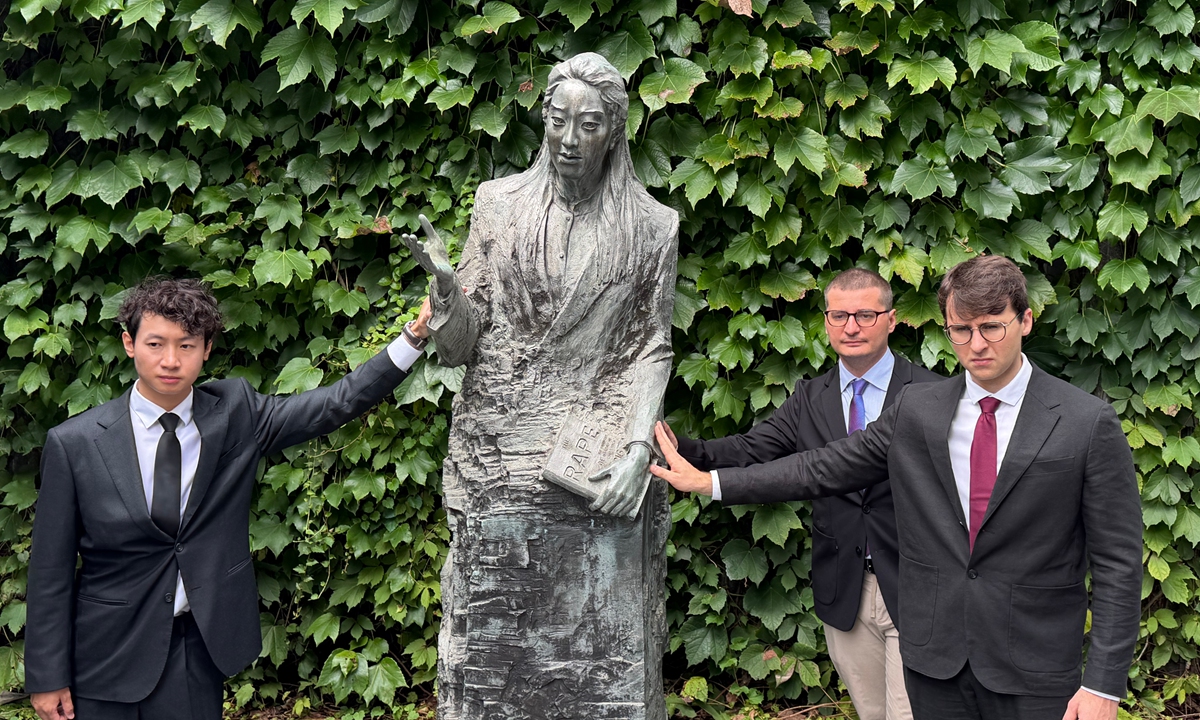
Marcus told Global Times on Saturday that, through these archives and related research, they have gained a deeper understanding of the brutality of the Nanjing Massacre. He said that collecting these materials was also aimed at conducting more educational work to help more people learn about this period of history.
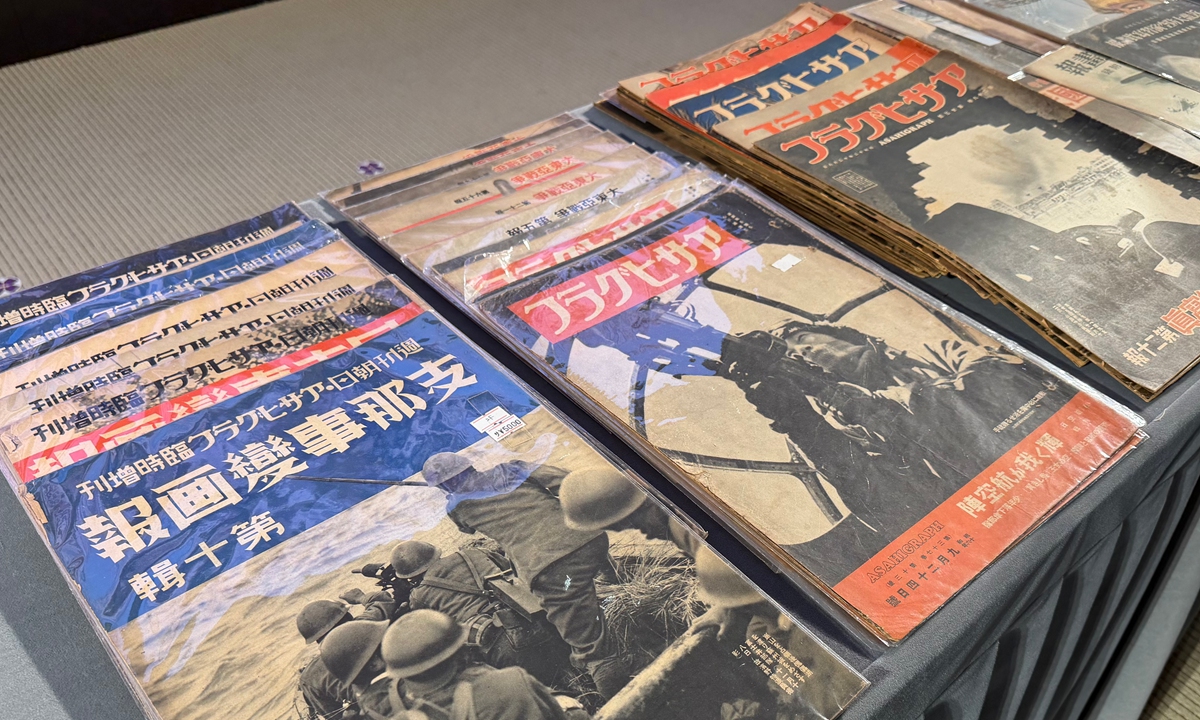
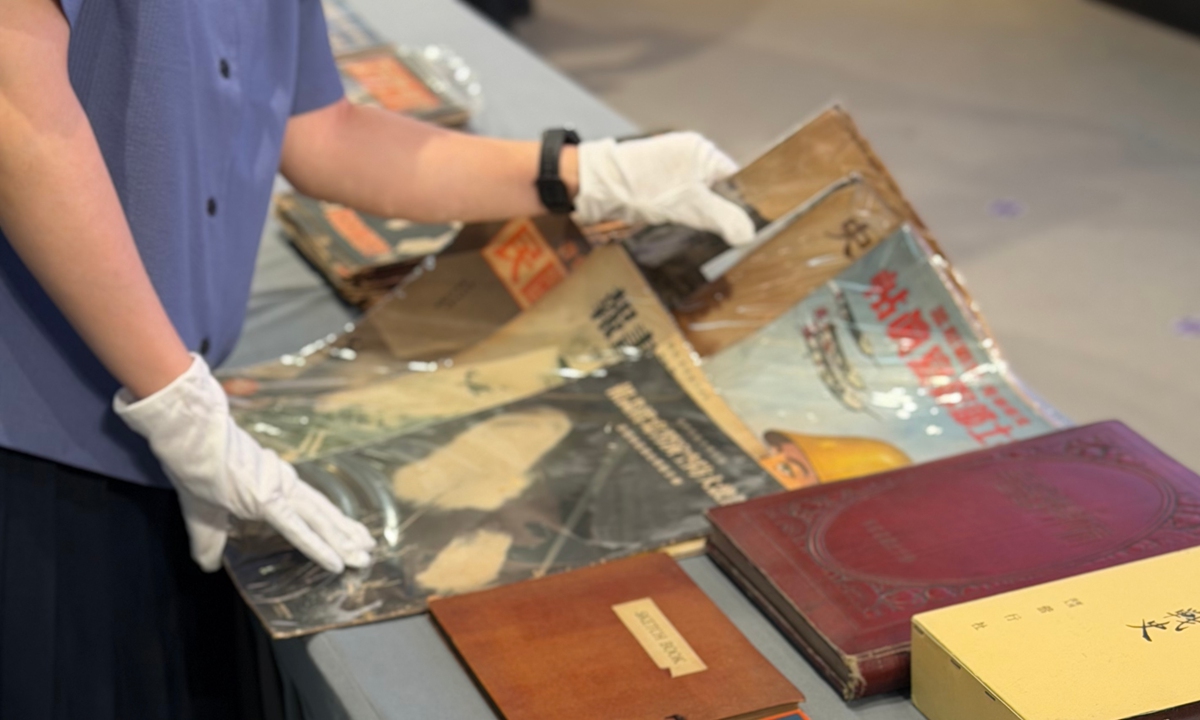
The materials brought back from Japan by Zhong include albums of documentary paintings of the Japanese invasion of China by artists accompanying the invading Japanese army, privately taken photo albums of the invading Japanese troops, and original publications from the same period, including the Asahi Shimbun. These materials all come from original Japanese records.
The overseas historical materials were collected over an extended period. Zhong said they contacted sources online and searched through antique and secondhand book channels while continuing to collect materials in Japan.
The new collection on Saturday also includes materials gathered by Chinese youths. High school student Yu Ningpeng and Xu Weizhe donated 12 private letters written by a soldier of the 20th Regiment of the Imperial Japanese Army’s 16th Division, documenting his experiences during the invasion of China. One letter, dated December 20, 1937, contains accounts related to the Japanese occupation of Nanjing.
Meng Guoxiang, a researcher at the Institute for National Memory and International Peace Studies, told the Global Times at the event on Saturday that historical research places great importance on the sources of historical materials, with original archives holding significant value.
Some of the materials donated this time were records left by the perpetrators themselves, while archives from third-party countries such as France provide another perspective, Meng said, adding that cross-checking materials from different sources can help build a more complete body of evidence.
Notably, alongside the handover of the latest batch of archival materials, the memorial hall also held a ceremony to induct the fifth group of inheritors of the historical memory of the Nanjing Massacre. Six people were named as the latest inheritors, including descendants of Nanjing Massacre survivors, descendants of eyewitnesses, and descendants of international friends. They help pass on historical memory through family traditions, educational activities and efforts to raise public awareness of history.
In recent years, a growing number of post-1990s and post-2000s private collectors, as well as foreign nationals, have joined efforts to collect historical materials, a trend that has deeply moved and impressed Zhou Feng, curator of the Memorial Hall of the Victims in Nanjing Massacre by Japanese Invaders, he told the Global Times.
Zhou said that preserving history and historical records was once widely seen as the responsibility of museums, cultural institutions and professional scholars; however, today, more and more private collectors are taking the initiative, spending their own money to collect historical materials scattered across China and overseas.
Historical memory, he said, needs to be passed down from one generation to the next. The donors come from different generations, nationalities and backgrounds, but share a common respect for historical truth and commitment to justice.
Since the beginning of this year, the memorial hall’s Nanjing Massacre Documents Center has launched a global campaign to collect relevant historical materials, receiving support from various sectors both in China and abroad. Nearly 100 donors from China and overseas have so far contributed materials to the memorial hall, Zhou said.
。

B | CANBERRA, Australia -- A Chinese Australian journalist who was convicted on murky espionage charges and detained in China for three years has returned to Australia, Prime Minister Anthony Albanese said Wednesday.Cheng Lei, 48, worked for the international department of China's state broadcaster CCTV. She has reunited with her two children in Melbourne, Albanese said.Her return comes ahead of Albanese’s planned visit to Beijing this year on a date yet to be announced. He will become the first Australian prime minister to visit the Chinese capital in seven years.Albanese said Australia had traded nothing with China for Cheng's release.“Her release follows the completion of judicial processes in China,” he said.China’s Ministry of State Security said that Cheng had been approached by a foreign organization in May 2020 and provided them with state secrets she had obtained on the job in violation of a confidentiality clause signed with her employer. A police statement did not name the organization or say what the secrets were.A court in Beijing convicted her of illegally providing state secrets abroad and she was sentenced to two years and 11 months, the statement said. She was deported Wednesday after serving her sentence, presumably because she had already been detained for that long .“Her return brings an end to a very difficult few years for Ms. Cheng and her family," Albanese said. "The government has been seeking this for a long period of time and her return will be warmly welcomed not just by her family and friends but by all Australians.”The FreeChengLei account on X, formerly known as Twitter, posted a photo of Cheng with Australian Foreign Minister Penny Wong and Australia's ambassador to China, Graham Fletcher.The post included a quote, apparently from Cheng, that read: “Tight hugs, teary screams, holding my kids in the spring sunshine. Trees shimmy from the breeze. I can see the entirety of the sky now! Thank you Aussies.”Albanese’s government has been lobbying for the release of Cheng and another Chinese Australian held in China since 2019, Yang Hengjun.Bilateral relations have improved since Albanese's center-left Labor Party was elected after nine years of conservative rule. Beijing has lifted several official and unofficial trade barriers on Australian exports.Albanese's reference to China's judicial system suggested that Cheng had recently been sentenced after she was convicted in a closed-court trial last year on national security charges.Questioned by a reporter, Albanese said China was not acknowledging through Cheng's release that she posed no threat or had been wrongfully detained.“No, China would have not have said that that's the position. China would say that the judicial processes have been completed in China,” Albanese said.Chinese Foreign Ministry spokesperson Wang Wenbin said that the Chinese judicial system tried the case “in accordance with the law, fully safeguarding the rights enjoyed by the person concerned in accordance with the law.”Albanese said he spoke to Cheng in Melbourne, where her children have been living with her mother, and that they discussed a letter she had written to the Australian public in August to mark the third anniversary of her detention. The Chinese-born journalist spoke in her letter about her love for her adopted country.In the letter, she also described her living conditions in detention in China, saying she was allowed to stand in sunlight for just 10 hours a year.“She is a very strong and resilient person ... and when I spoke with her she was delighted to be back in Melbourne,” Albanese said.Albanese did not say whether Yang was also likely to be released.“We continue to advocate for Dr. Yang’s interests, rights and wellbeing with the Chinese authorities at all levels,” Albanese said.Yang, a 58-year-old writer and democracy blogger, told his family in August he fears he will die in a Beijing detention center after being diagnosed with a kidney cyst, prompting supporters to demand his release for medical treatment.Yang has been detained in China since January 2019, when he arrived in Guangzhou from New York with his wife and teenage stepdaughter.Yang received a closed-door trial on an espionage charge in Beijing in May 2021 and is still awaiting a verdict.Yang's friend, University of Technology Sydney academic Feng Chongyi, said on Wednesday a verdict had been postponed for three months 11 times and the next possible ruling was January.He said Cheng’s release was good news for Yang. “I do hope Yang is treated in the same way. Given Yang’s poor health, his release is actually more urgent,” Feng said.___Associated Press writer Ken Moritsugu in Beijing contributed to this report.___This story corrects the name of the Chinese security agency.。
Current article:http://lzu23.bianneixuanbingqinyouxie.buzz/news/20260826_4969637.html
Published on:22:38:24


